
Pioneering Distributed Logic Control (DLC) for the Snowy Mountains
How a fault-tolerant SCADA solution developed in 1992 anticipated many of the principles of modern edge computing.
by Glyn Calluthers – Software Engineer
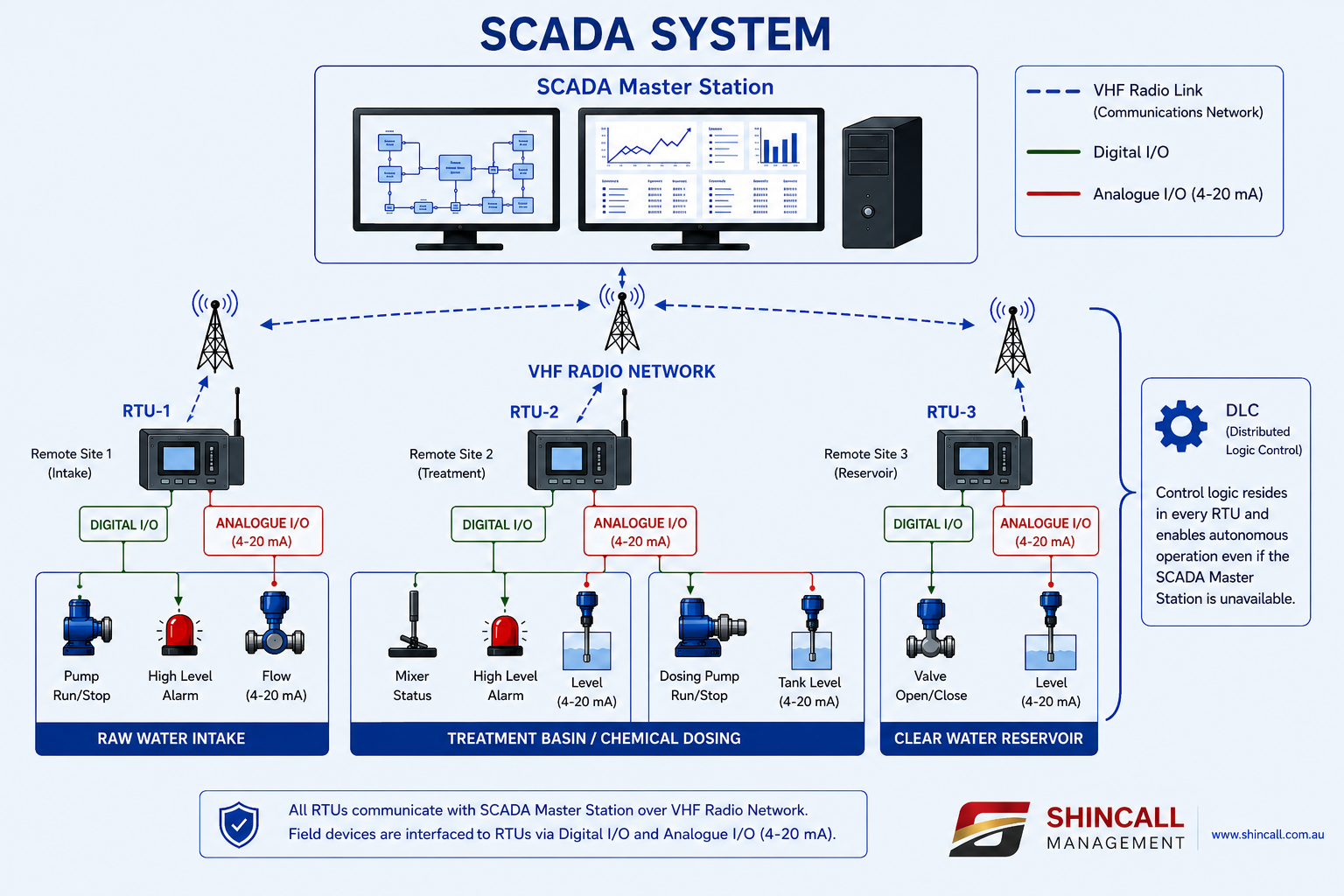
SCADA system with built in Distributed Logic Control (DLC)
In 1989, Glyn Calluthers joined Elpro Technologies as a Software Engineer, developing embedded C and Assembly language software for Motorola 6809 and 68HC11 microprocessor-based products.
In 1992, Elpro Technologies was approached by the Snowy Mountains Hydro-Electric Authority (SMHEA, now Snowy Hydro) to provide a SCADA system for monitoring and controlling a municipal water supply and treatment network. Unlike conventional SCADA systems of the time, the customer required the system to continue operating even if the central control computer went offline.
The challenge was handed to Calluthers to solve. His response was to create a distributed control model that he named Distributed Logic Control (DLC). Today, the principles of distributing intelligence to remote devices are widely seen in Distributed Control Systems (DCS), Industrial IoT, and Edge Computing architectures, where processing and decision-making occur closer to the field devices rather than relying entirely on a centralised control system.
The solution was a proprietary system using ELPRO-developed Remote Telemetry Units (RTUs) connected via long-range VHF radio communications. The DLC architecture used a master-slave model in which every RTU maintained a complete copy of the control logic. At start-up, a network-wide handshake routine elected the master RTU, enabling the system to continue operating autonomously whenever the central computer was unavailable.
The key concepts of the system were:
Each remote site (water treatment plant, reservoir, pump station, etc.) contained local intelligence.
Local controllers could continue operating autonomously if the central SCADA computer failed.
The central computer could gracefully resume supervisory control when it returned online.
Radio telemetry linked the various sites together, leveraging one of ELPRO's core specialities.
For a municipal water supply and treatment system, the DLC approach provided digital and analogue I/O control for:
Automatic reservoir level management.
Pump sequencing and duty/standby changeover.
Alarm handling and event logging.
Continued operation during SCADA server outages.
Graceful resynchronisation when the central system returned online.
In the early 1990s, this "distributed intelligence" approach was well ahead of its time. The DLC architecture demonstrated that resilient, autonomous control could be achieved by distributing intelligence to the network edge—an approach that has since become a fundamental principle of modern industrial automation, distributed control systems, Industrial IoT, and edge computing. At the time, many water utilities still relied on master-station-centric SCADA systems where the loss of the central computer could significantly impair operations. By contrast, the Snowy Mountains DLC solution continued to operate autonomously, maintaining local control and system resilience even during communication or central system failures.
Lessons Learned
Innovation often comes from solving practical problems rather than pursuing new technology for its own sake. The need for fault tolerance and operational resilience led to a distributed control architecture that anticipated many of the principles used in modern edge computing systems.
"At the time, we weren't trying to invent a new computing paradigm; we were simply solving a practical problem—how to keep a critical water system operating if the central computer failed. Looking back, it was an early example of what is now called edge computing."
— Glyn Calluthers