
Winning the South-East Queensland Go Card Ticketing Contract in 2003
The Go Card Ticketing Contract was far more than a new smartcard ticketing solution; it was a fully-fledged, customer-centric end-to-end ecosystem.
by Glyn Calluthers – Software Manager | Project Engineer | IT Operations Manager
Prior to 2003, South East Queensland's public transport network relied on ERG's Integrated Ticketing System (ITS), using a combination of paper and magnetic-stripe tickets across rail, bus and ferry services. ITS used ERG device for rail, Whereas Bus and Ferry used ERG validators for mag-stripe tickets, and a Wayfarer driver console for paper tickets and driver operations. With the rise in Smartcard technology, the Queensland Department of Transport and Main Roads (TMR), TransLink Division went out to tender to replace the mag-stripe ticket with a smartcard solution across all modes of transport, known as the Smartcard Integrated Ticketing System (SITS).
The new technology introduced a tap-on and tap-off approach instead of the mechanical reading of a mag-stripe ticket, thereby providing an improved greater customer experience. The cutting-edge technology of the smartcard would bring an array of improved customer experiences including having prestored value on a card that you could keep rather than continually having to buy new tickets, the easy of contactless validation, on-line card top-ups with directed autoloads, and self-replenishing top-ups with threshold autoload. Threshold autoloads had the most impactful customer experience by removing the need to ever approach a ticket machine or window again to buy a ticket or reload a smartcard, which is especially useful when your train is about to arrive!
The smartcard technology was unfolding in Sydney in parallel to this where ERG subsidiary ITS had won the Sydney smartcard (Tcard) contract in February of 2003 ahead of Cubic at the time; however, Cubic continued to preserver in competing for the SEQ contract.
Following the successful delivery of the Sydney Airport Link Ticket Vending Machine project, Calluthers was assigned responsibility for defining the Central Back Office solution for Cubic's tender response. Like the Sydney Tcard contract, the SITS, included a full 10-year Operation and Maintenance (O&M) component in addition to the standard Design and Build (D&B). Developing the Central Back Office proposal required bringing together numerous operational disciplines into a single integrated solution. This included IT infrastructure, financial services, asset management, field services, retailer support, disaster recovery, network connectivity, service level management and comprehensive operational reporting. Together, these capabilities formed the operational foundation required to support a modern, customer-centric smartcard ticketing system.
Cubic was successful bidder and was awarded the $134M SITS contract in July 2003, later to be known as the Go Card contract. Winning the contract was only the beginning. The proposed Central Back Office would become the operational heart of the entire Go Card system, processing millions of customer transactions, supporting retailers, managing financial clearing, monitoring thousands of field devices and ensuring the network operated around the clock.
Following contract award TransLink became aware of what it would mean to the public if the fare structure were to be normalised so that no matter where you travelled, the zonal fare would be the same irrespective of what mode of travel you took, rail, bus or ferry. TransLink could see a real opportunity here to improve the customer experience. This had the added benefit of vastly simplifying the business rules and thereby reducing the complexity of the system and its associated risk to the programs delivery schedule. This decision by TransLink proved to be a very smart move, one that Sydney did not take at the time and inevitably became a contributing factor to the unsuccessful delivery of the Sydney Tcard by ERG.
To normalise the SITS fare structure, TransLink awarded a Stage 1 variation to ERG of May 2006 to update all the existing ITS across Rail, Bus and Ferry as a precursor to rolling out the Cubic based SITS solution. This was achieved, by originally creating 23 concentric zones rippling outwards from the Brisbane CBD up north to Gympie, out west past Ipswich to Helidon, and down south to the NSW boarder on Bus and Robina on Rail. Consequently the system colloquially became known as the South-East Integrated Ticketing System (SEQITS). Later, on the 1st of January 2017 the network was normalised even further to 8 larger zones as announced by the Queensland Governments media statements.
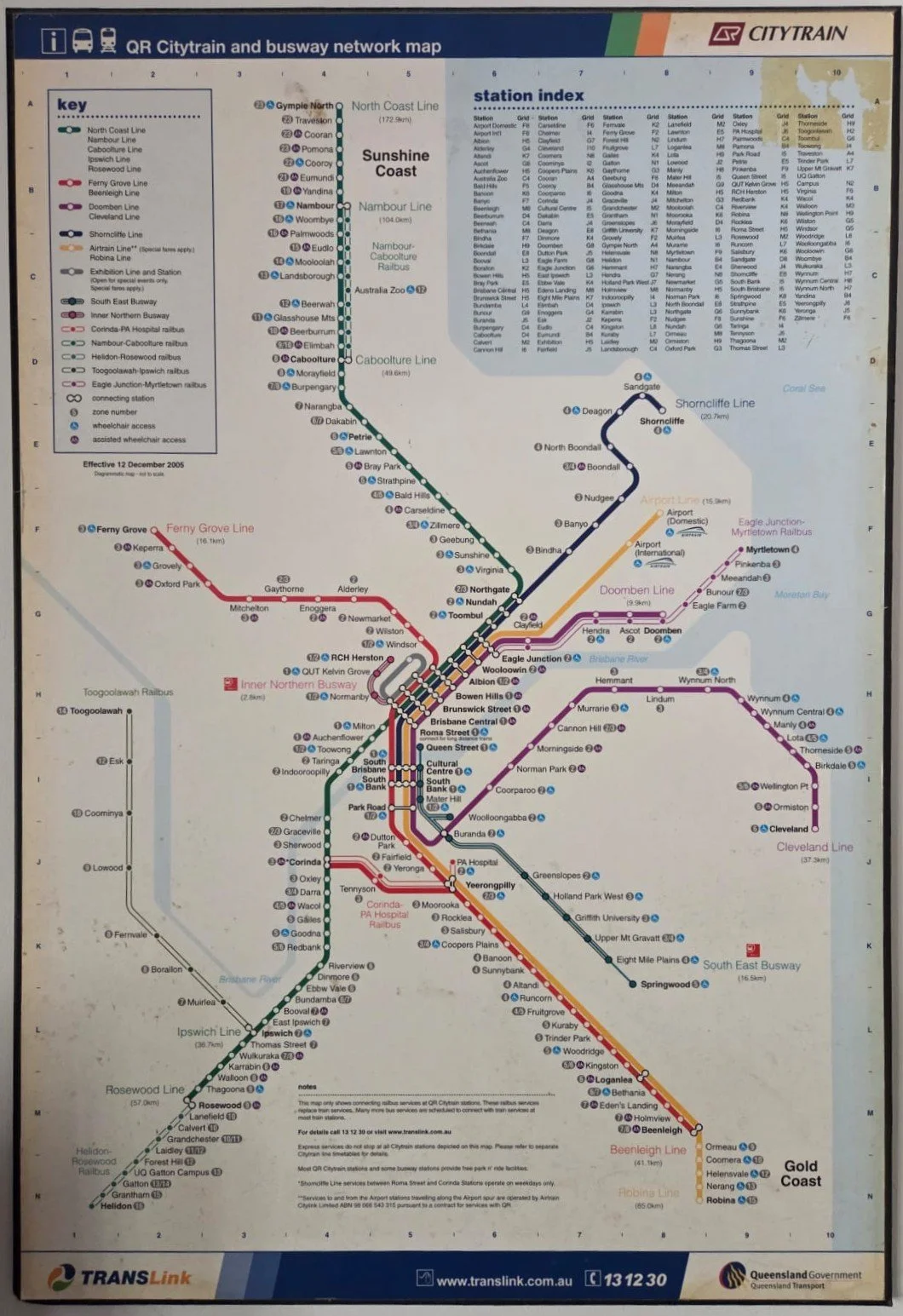
Figure. Original 23-zone South East Queensland Integrated Ticketing System (SEQITS) network prior to fare normalisation. Source: Queensland Rail CityTrain network map (2005).
Stage 1 became the dependant precursor to the Stage 2 rollout of SEQITS, that:
Replaced the legacy rail, bus and ferry equipment, supporting both:
Contactless smartcards (go card), and
Paper tickets.
Provided a common back office and revenue clearinghouse system.
Deployed new validators, ticket vending machines, gates and retail infrastructure.
Cubic’s commenced the deployment of paper tickets on the new devices in 2006 with full rollout of smartcard capability in 2008, accompanied with full operational services. This was Cubic’s first contract that included 10-years of Operations and Maintenance (O&M) and Calluthers transitioned from being the Project Engineer driving the delivery of the back-office to become Cubic’s first IT Operations manager to operate the back-office. In this era the role was referred to as Central Systems Manager; however, in todays terms it is commonly called IT Operations Manager, or Managed Services Manager. This career progression represented far more than just a role change, it was a complete mindset change moving from an Engineering design and delivery mindset to an Operational performance, continuous improvement, and customer-centric mindset. Establishing first hand experience in both Engineering and Operations has proved to be valuable combination when developing customer-centric products with a service component.
The Queensland Government's monthly performance data demonstrated the success of the project through higher patronage volumes, lower complaint rates per trip, and stable Go Card fixed-fare adjustments (Ref. TransLink Public Transport Performance Snapshots). A decade after the contract was awarded, the system continued to deliver high levels of customer satisfaction and was recognised by the peak industry body, the Tourism & Transport Forum (TTF), as Australia's leading smartcard ticketing system. The long-term success of the Go Card program helped shape Cubic's global approach to managed services, establishing the company's managed services model as the benchmark for winning future operations and maintenance contracts (Ref. Cubic Celebrates Ten Years Since Signing go card Contract).
The launch of the Go Card project in 2008 became arguably Australia's most successful smartcard ticketing operation. By combining innovative smartcard technology with a fully managed operational service, it demonstrated how customer-focused operations could transform the public transport experience across an entire metropolitan network.
Lessons Learned
Looking back, the greatest success of the project wasn't simply replacing magnetic-stripe tickets with smartcards. It was creating a simpler, fairer and more customer-focused ticketing system that transformed how people travelled throughout South East Queensland.
“It was certainly a case of being responsible to deliver what you promised; however, I felt I was taking this to the next level to manage and operate what I had delivered. Yet, at the time this was not a consideration, I was simply focused on providing the best customer success story for the Queensland Government and the people of Sout-East Queensland”.
- Glyn Calluthers
Project Summary
Year: 2003
Customer: Queensland Department of Transport and Main Roads (TMR), TransLink Division
Company: Cubic Transportation Systems Australia
Role: Project Engineer
Technology: Mifare Classic EV1 NXP smartcard, Coda, Metrix, Hummingbird, Cognos, HP, Cisco, Hitachi Storage
Innovation: Delivered Queensland's first integrated smartcard ticketing platform, combining customer convenience with a fully managed operational back office.