
TVM4K Touchscreen delivered for Sydney 2000 Olympics
How can we extend the Sydney AirportLink Touchscreen Ticket Vending Machine to the wider CityRail network?
by Glyn Calluthers – Senior Software Engineer
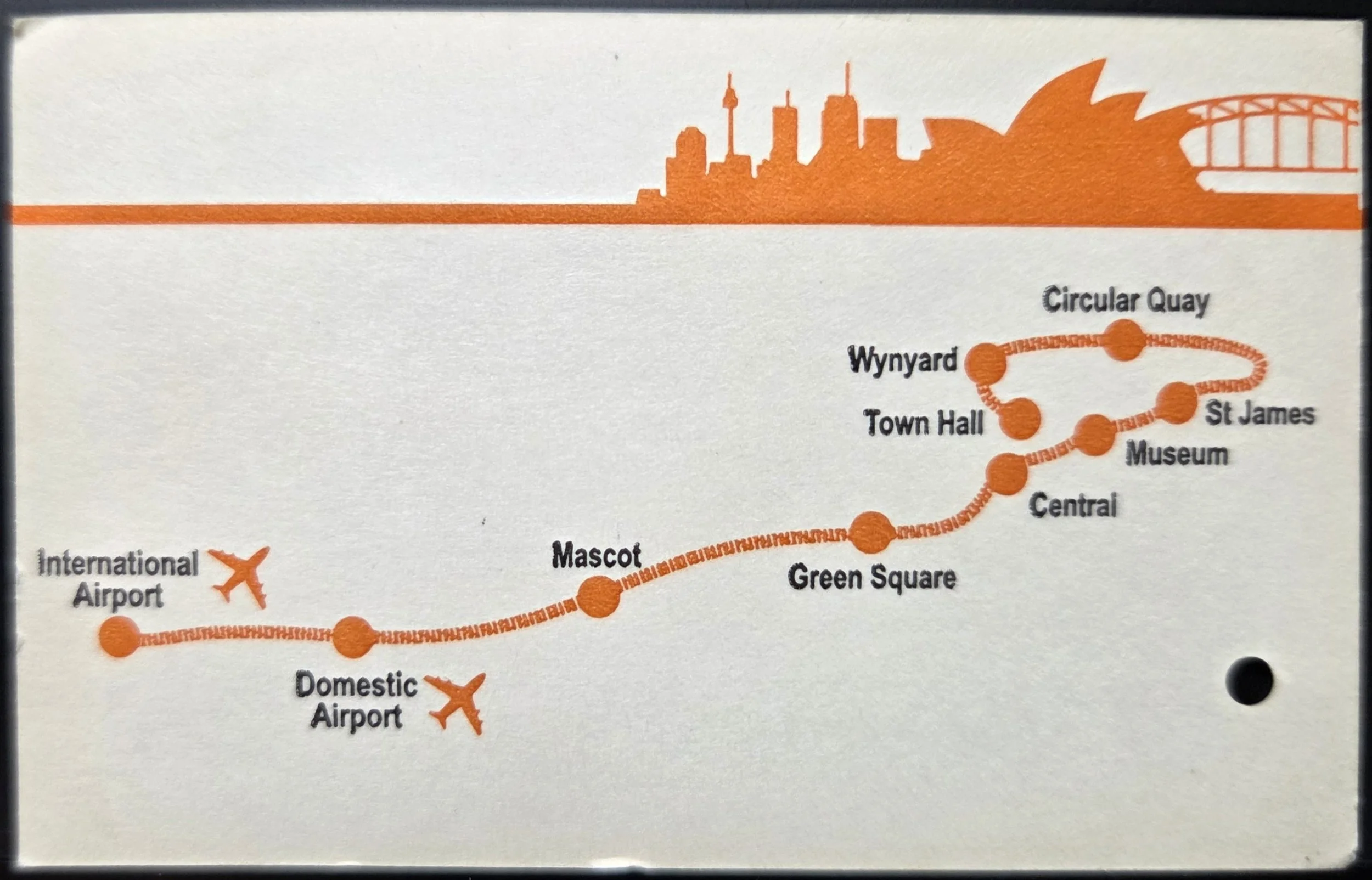
Airport Link mag-stripe ticket reverse-side.
As part of the Airport Link development project and in preparation for the Sydney 2000 Olympic Games, the New South Wales State Rail Authority (SRA) worked with Sydney Airport Link Company to deliver a new generation of multi-lingual touchscreen ticket vending machines.
Unlike publicly owned CityRail, the Airport Link Company was a privately operated railway that applied an additional station access surcharge to recover its infrastructure investment. As the Airport Link train line was expected to serve large numbers of international visitors during the Sydney 2000 Olympic Games, Airport Link required a modern ticket vending solution that could support multiple languages and provide an intuitive touchscreen interface for infrequent users and tourists.
Glyn Calluthers led a small team of software engineers at Cubic Transportation Systems to develop what became Cubic's first touchscreen ticket vending machine in the Asia-Pacific region.
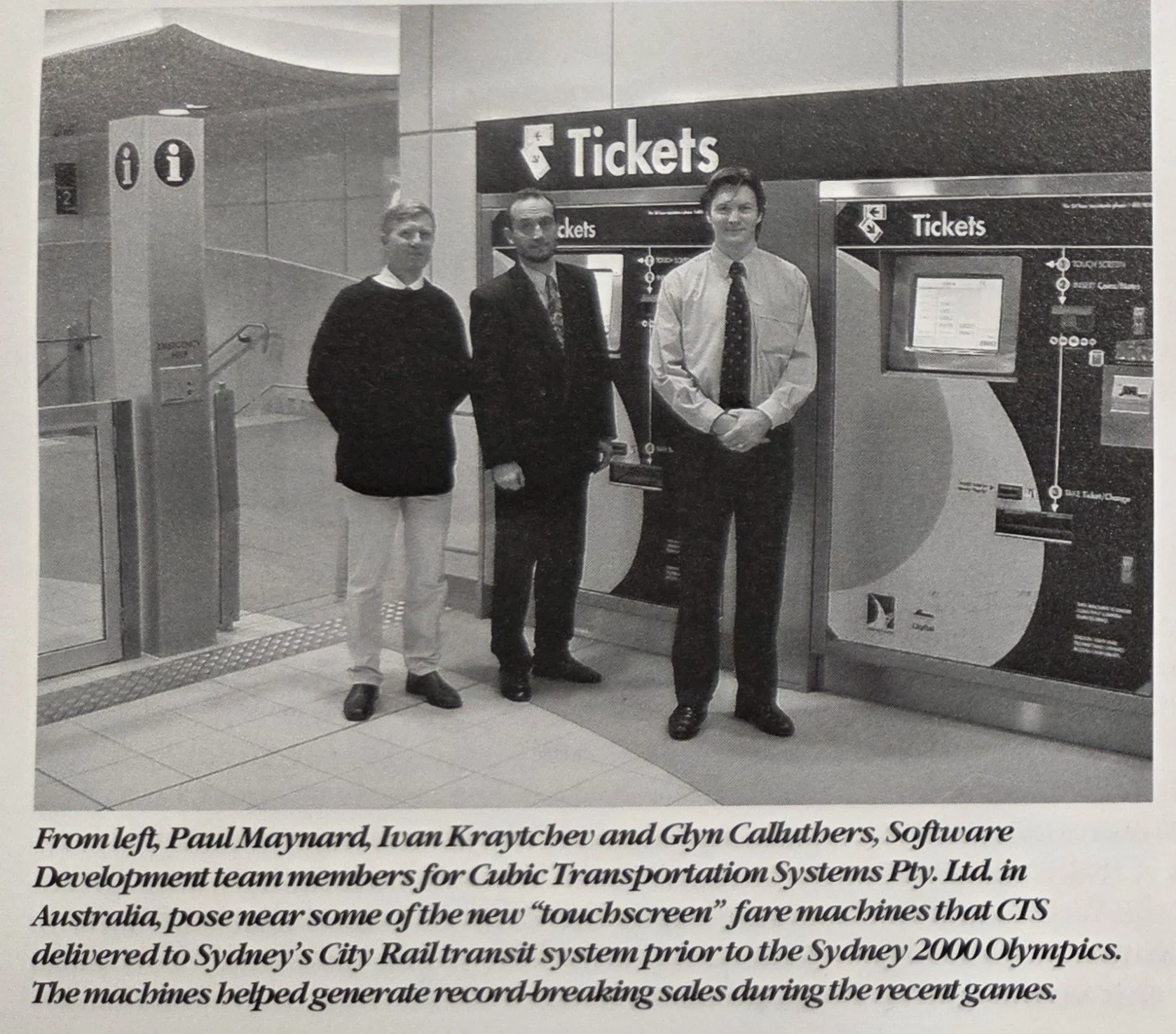
Source: Cubic Circuit, November 2000, by Cubic Corporation.
At the time, Cubic had already delivered the Ticket Vending Machine Type 4 (TVM4) across Sydney's rail network of approximately 340 stations. Each TVM4 featured a front panel containing a full matrix array of destination buttons, with one button allocated to each station on the network and several spare buttons reserved for future expansion. When a passenger selected a destination, the machine calculated the appropriate fare and encoded and printed a magnetic ticket.
Calluthers recognised that the existing design could be significantly improved through innovation rather than by designing an entirely new machine. He proposed replacing the existing button-panel front door with a touchscreen assembly and mounting a Single Board Computer (SBC) on the inside left panel of the machine.
The SBC would not only drives the touchscreen interface but would also assume responsibility for fare calculations and communications with the central computer, functions previously performed by the in machine Intel 8051-based coordinator board.
This architecture provided two major advantages. First, it enabled the rapid delivery of a modern touchscreen ticket vending machine in time for the Olympics. Using a Liquid Crystal Display (LCD) over a Cathode Ray Tube (CRT) also meant eliminating the need for a screen saver because LCD displays were not susceptible to the phosphor burn-in issues associated with CRT technology. Not having a screen save meant allowing the ticket selection screen to remain permanently visible to customers and significantly improving the user experience. The overall solution created a low-cost upgrade path for all existing SRA TVM4 machines. By replacing only the front door, installing a Windows NT based SBC with the LCD drivers built in, and fitting a new wiring harness, any existing TVM4 could be converted into what became known as the TVM4K, "K" denoted the machine's new kiosk-style touchscreen interface. The proposal demonstrated that a major technology refresh could be achieved through an evolutionary upgrade of the existing platform rather than a costly replacement of the entire ticket vending fleet.
The original TVM4K featured a blue and white cabinet with a landscape industrial LCD touchscreen with resistive touch technology, allowing operation by passengers wearing gloves or using a fingernail. Unlike later generations of Sydney ticket vending machines, the original Airport Link TVM4K supported cash payments and magnetic ticket issuance only, with integrated EFTPOS facilities being introduced in later generations. The machine's modern appearance and touchscreen interface represented one of the earliest large-scale deployments of touchscreen ticket vending technology in Australian public transport.
The upgrade architecture demonstrated that significant innovation could be achieved by repurposing existing infrastructure. Rather than replacing an entire fleet of machines. The TVM4K concept extended the life of the existing TVM4 investment while simultaneously introducing modern touchscreen technology and a far more flexible software architecture.
Calluthers designed the interface specifications to the central computer, enabling the touchscreen configuration, fare tables and product definitions to be downloaded remotely. This represented a significant improvement over the previous system.
For example, special fare products such as the annual Sydney Royal Easter Show ticket had previously required technicians to physically visit every machine, enable the fare and apply a new button label to a spare door button. Under the new architecture, products could be added or removed remotely, thereby reducing the cost of a field visit by a technician and providing an instant configuration change system wide, avoiding the issue with customers selecting a product that is no longer valid.
Following the successful delivery of the Airport Link project and its enhanced performance during the Sydney 2000 Olympic Games, the innovation was recognised at the 2001 Western Sydney Industry Awards, where Cubic Transportation Systems (Australia) Pty Limited received first place for the Product Innovation Award.
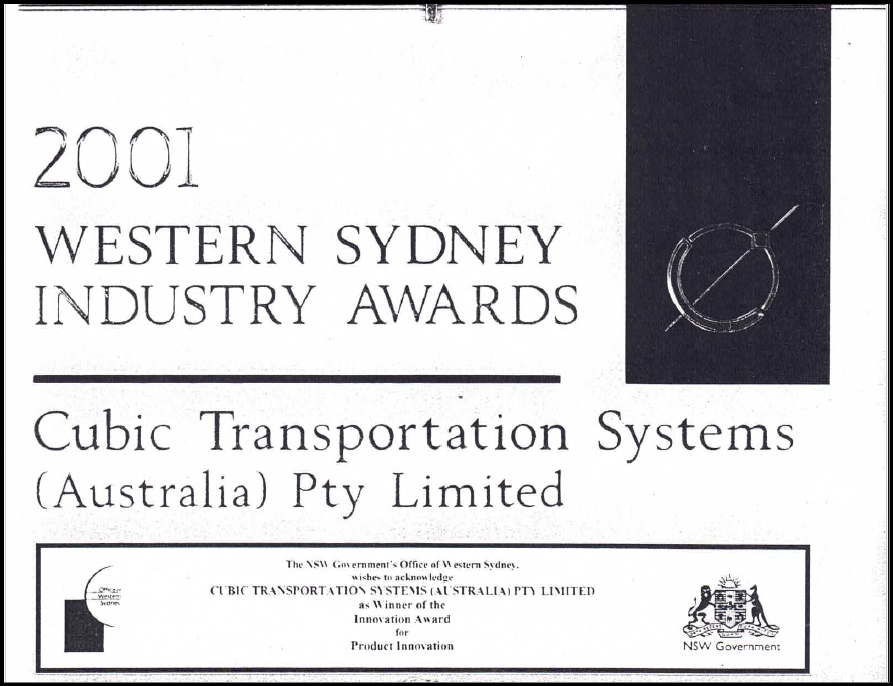
Source: Photocopy of the award WSIA certificate 2001 for Innovation.
Although the original coordinator board no longer performed fare or transaction processing, it was retained as the machine's peripheral controller. It continued to interface with the Mars coin acceptor and Cubic's proprietary FIFO coin manifold and tube assemblies, coin hoppers, magnetic ticket printer and encoder, and the Sodeco BNA57 banknote acceptor.
To support this architecture, Calluthers developed a new communications interface specification between the SBC and the coordinator board.
The new SBC operated under Microsoft Windows NT and utilised a FoxPro database, marking the first time Cubic had introduced an internal database into a ticket vending machine. This significantly increased the flexibility of the internal management, storage and retrieval of configuration data.
Drawing upon his extensive understanding of the SRA fare structure and business rules, Calluthers personally developed the Fare Manager (FMAN) in C++, ensuring that all fare calculations were performed accurately. The graphics were developed by contractor software engineers in Visual Basic.
The new TVM4K and its software were delivered on schedule and successfully demonstrated to the NSW Minister for Transport during the official opening on 18 May 2000, prior to public operation commencing on 21 May 2000.
The TVM4K proved to be more reliable than its TVM4 predecessor with higher availability measurements and provided a cost-effective upgrade path for the remaining SRA TVM4 fleet.

Airport Link mag-stripe ticket front-side .
A ticket issued from an Airport Link TVM4K in November 2010, more than ten years after the machines entered service, stands as a small but tangible reminder of the longevity of the platform and the success of its upgrade architecture.
Project Impact
The TVM4K touchscreen represented one of the first deployments of touchscreen technology in a high-volume Australian public transport ticket vending machine. Designed and delivered in time for the Sydney 2000 Olympic Games, it demonstrated how software-driven user interfaces could replace fixed hardware controls while simplifying machine configuration and improving the passenger experience. Many of the design principles pioneered in this project became commonplace in public transport ticketing systems over the following decades.
Innovation
The TVM4K became a multi-faceted work of innovation breaking grounds on, full remote screen configuration, embedded database, reusable infrastructure, and most importantly repurposing existing infrastructure, avoiding the complete removal and installation of 100’s of TVMs across the entire fleet.
"The real challenge wasn't building a touchscreen machine; it was delivering a completely new customer experience within an immovable project deadline."
— Glyn Calluthers
Project Summary
Year: 2000
Customer: Airport Link Company, and NSW State Rail Authority (CityRail)
Company: Cubic Transportation Systems Australia
Role: Senior Software Engineer
Technology: SBC, LCD touchscreen, Windows NT, Motorola 8051, FoxPro, C, C++, Visual Basic
Innovation: Fully configurable and reusable Touchscreen TVM